AND THE STANDARDIZATION OF ARTHURIAN LEGEND
1485–1600’s
In 1485, two events happened that would shape English language and culture for centuries. Henry Tudor founded a new dynasty, and William Caxton printed Le Morte d’Arthur.
Linguistic QuestioN:
What happens when a language’s spelling begins to freeze because of a historical moment, and why does that moment matter for how we read and write English today?
TWO LANDMARKS, ONE YEAR
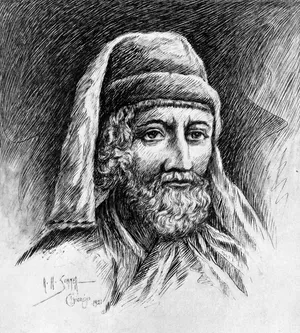
Public Domain Image, Sommer, R.H., engraving, 1921 https://www.britannica.com/biography/William-Caxton
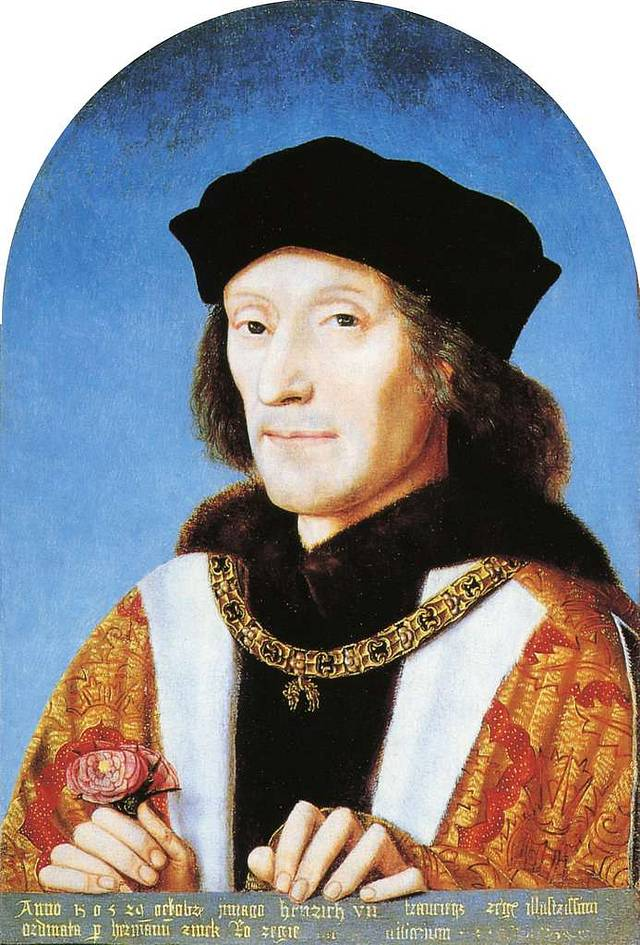
Henry Tudor, otherwise known as King Henry VII, claimed the English throne in 1485 by defeating King Richard III at the Battle of Bosworth Field, founding the Tudor dynasty that would rule England for over a century. His claim was political, but he reinforced it with mythology. As Snyder explains, Henry VII traced his lineage to Cadwallader, “the last king of the Britons” according to Geoffrey of Monmouth, “and ultimately (a descendant) of Arthur himself,” (133). A king who could claim descent from Arthur could claim not just political legitimacy but mythic legitimacy. To make that connection visible, King Henry VII named his firstborn son Arthur, born in Winchester, the city Malory had identified as Camelot, so that there might, “once more be a king of that name in Britain,” (Snyder, 133). Caxton’s decision to print Le Morte d’Arthur in that same year was not incidental to any of this. The legend and the dynasty arrived together because each one served the other.
WHAT CAXTON DID TO ARTHURIAN LEGEND
Caxton’s preface to Le Morte d’Arthur describes his project in a way that reveals exactly what print meant for the Arthurian legend. He writes:
“I have… emprised to imprint a book of the noble histories of the said King Arthur… Sir Thomas Malorye did take out of certain books of French, and reduced it into English. And I, according to my copy, have set in imprint, to the intent that noble men may see and learn the noble acts of chivalry, the gentle and virtuous deeds that some knights used in those days.”
William Caxton, Preface to Le Morte d’Arthur, 1485
This preface does several things. First, it acknowledges the French origin of the material. It then frames printing as an act of moral instruction. It also positions the printed book as the authoritative text for a legend that had previously existed in dozens of manuscript variants, with none of them being identical. Before Caxton, every scribe spelled by ear and regional convention. As Gramley explains, Early Modern English orthography “underwent a high degree of regulation in the hands of the printers,” (121). This meant that Caxton had to choose spellings and make editorial decisions that would be reproduced identically in every copy.
CAXTON’S EDITING
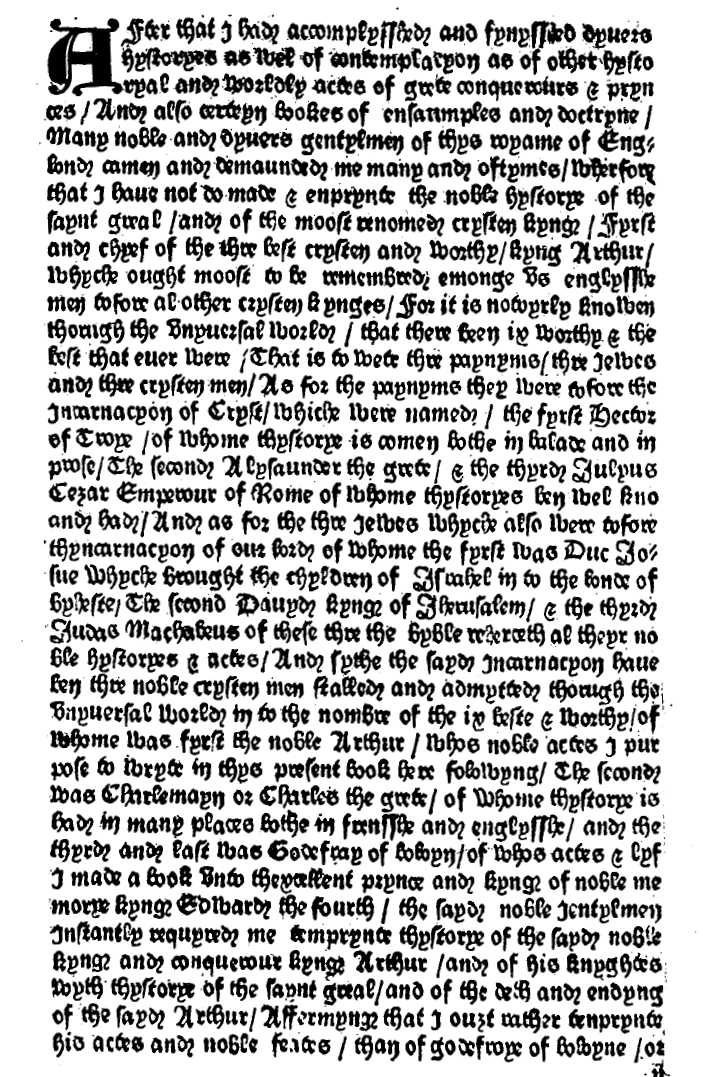
William Caxton didn’t simply print Malory’s manuscript of Le Morte d’Arthur unchanged. As the Norton Anthology of English Literature explains, he “welded these together into twenty-one books, subdivided into short chapters with summary chapter headings” and “suppressed all but the last of the personal remarks the author had appended to individual tales,” (603) in order to create a continuous narrative. The Winchester Manuscript, a second manuscript of Malory’s Le Morte d’Arthur discovered in 1934, shows significant differences from Caxton’s printed text. This demonstrates that what we call “Malory’s Le Morte d’Arthur” is partly Caxton’s editorial construction.
THE LEGEND GETS FIXED
Print froze the legend of King Arthur in a way that oral tradition and handwritten manuscripts never could. Before Caxton, there was not one single version of the Arthurian story that had “authority” over any other. There was no defined version of Arthur’s story and legacy. Manuscripts were only really available locally and varied in ways that contradicted each other without consequence. Caxton’s printing press and printed books in general changed that entirely, establishing a fixed text that all subsequent versions would have to knowingly engage with or argue against.
Yet even as print fixed the legend, it also opened it up to new scrutiny. The same technology that gave the legend authority also gave its critics a platform of equal reach. Caxton himself acknowledged this in his preface, noting that some men “hold opinion that there was no such Arthur, and that all such books as been made of him be feigned and fables,” (Malory, “Preface of William Caxton). This skepticism was not new, but print made it consequential in a way it had never been before.
The debate on the historicity of King Arthur sharpened considerably in the sixteenth century, when humanist scholars began applying criticism to medieval historical sources. As Snyder notes, the Italian humanist Polydore Virgil dismissed Geoffrey of Monmouth and the medieval chroniclers in his Historia of 1534, by arguing that their accounts of Arthur were unreliable legend rather than history, (133). The response was fierce. Protestant nationalists and Tudor apologists pushed back with chronicles that exalted Arthur’s deeds, because the Tudor dynasty had staked part of its legitimacy on its “Arthurian inheritance.” The debate over Arthur’s historicity was being conducted, for the first time, in print, and for the first time, it had direct political consequences for the people in power.
LANGUAGE AND LEGEND BEGIN TO STABILIZE
Gramley describes how the first printers, “failed to make the adjustments which would have brought English orthography more closely into line with the traditional values of the letters,” and “respect for learning and a recognition of the etymologies of numerous words led to changes which made their words more Latin-like,” (121). This means that they started to fix spellings at a particular historical moment that didn’t perfectly reflect pronunciation. This is partially why English spelling seems so irregular today, as the start of its standardization occurred during and just before the Great Vowel Shift. Caxton’s version of Malory’s Le Morte d’Arthur, with its spellings of “kynge” instead of “king,” “sayd” instead of “said,” “knyghte” instead of “knight,” and more, sit at this very moment, (Malory).
So what does this all mean? Well, this means that the same press that fixed the story of King Arthur into a single authoritative English text had also began to fix the spellings of the English language at the same time. The legend and the language were being standardized together. Every subsequent writer who retells the legend of King Arthur in English is therefore working within a linguistic framework that Caxton’s press helped create.
 The Word In The Stone