~500–1000 CE
The legend of King Arthur didn’t begin in a book or scroll, it began in the mouths of bards. The first recordings of this legend in text still bear the marks of this oral origin.
Linguistic Question:
How does a language’s structure shape the stories it can tell, and what is lost or changed when an oral tradition gets written down for the first time?
BEFORE ARTHUR WAS WRITTEN DOWN
The earliest written references to King Arthur are found in two different languages: Latin and Old Welsh. Both of these languages are known as synthetic languages. This means that these languages are highly inflectional: signalling grammatical relationships through word endings. Synthetic languages are unlike analytic languages, like modern day English, because analytic languages rely on helper words and word order to convey grammatical relationships instead. Because Latin and Old Welsh are synthetic languages, a noun will change its ending depending on whether it is the subject of an action, the object, or the owner of something. This matters because the grammar itself directly encodes social hierarchy into speech and writing.
THE NAME “ARTHUR”
Before examining the primary texts, it’s worth pausing on the name Arthur, because it is a linguistic artifact on its own. As Mees, author of King Arthur and the Languages of Britain, explains, the name reflects the expected Brittonic adaptation of the Roman family name Artorius, produced through a predictable sound change in which the long o of Latin Artorius developed to u in the ancient Brittonic dialects, (Mees, 28) The Roman family name Artorius was well known in inscriptions across the empire, and its presence in Britain is consistent with what Mees calls “a sophisticated Latinity” (Pg. 11) that is evidenced in fifth and sixth century British inscriptions which employ a mixture of Celtic and Roman names. The very name “Arthur” is a record of Latin and Celtic languages in contact.
Y GODODDIN AND WELSH ORAL TRADITION (~600-638, Debated)
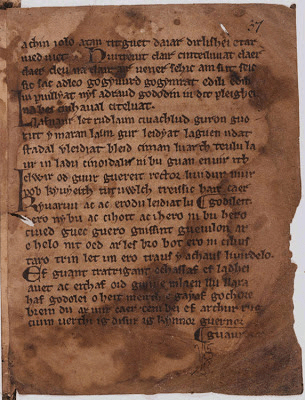
The Welsh poem “Y Gododdin” was composed by the court bard Aneirin around 600-638 CE, however only a 13th century manuscript survives today which has caused many to call into question its actual date of creation. Many date its creation in between the 7th and early 11th centuries, which makes it one of the oldest surviving works of Welsh poetry either way.
“Y Gododdin” contains what may be the oldest written reference to Arthur, and it’s a passing one. In “Y Gododdin,” a Welsh warrior is praised for his ferocity in battle, yet the poet notes that he still fell short of the greatest standard. As the author of The World of King Arthur, Christopher Snyder, observes, this passing reference “would appear to be proof that he was already, by the time of the poem’s composition, a figure well known to Aneirin’s audience in northern Britain,” (94). The casualness of the reference is evidence here that oral tradition doesn’t introduce famous figures, because it assumes that the audience already has heard tales of them. Mees notes that the poem, “seems likely to have been originally composed in an early Cumbric dialect and then translated into Primitive Welsh,” and that the surviving manuscript “is recorded in two hands, the first of which preserves characteristically Middle Welsh spellings and the other obviously Old Welsh forms,” (Mees, 82). The manuscript itself bears visible linguistic evidence of its journey from oral performance to written text across multiple dialects and centuries.
SIDE-BY-SIDE: The Arthur Line in “Y Gododdin”
Welsh (Original)
“Gochore brein du ar uur / Caer ceni bei ef Arthur”
English (Translation)
“He fed black ravens on the rampart of a fortress, / though he was no Arthur”
Aneirin, “Y Gododdin,” c. 600-638, trans. John Williams, 1852
NENNIUS AND THE HISTORIA BRITTONUM (~829-830)
One of the earliest written accounts of Arthur appears next in the Historia Brittonum, a Latin chronicle that was compiled around 830 CE and believed to be written by a Welsh monk named Nennius. The Historia Brittonum is a supposed history of early Britain that draws from Roman annals, church records, and oral tradition to preserve a history of the British people after Rome’s withdrawal from Britain. The Historia Brittonum is one of the most cited texts in debates about Arthur’s historicity, and scholars remain divided to this day on how much historical weight to give the text. This is because it was compiled centuries after the events it describes. Nennius himself even acknowledged that he was gathering fragments of history, rather than recording firsthand knowledge. Nennius describes The Historia Brittonum as a compilation gathered from whatever sources he could find (Nennius, “I. The Prologue”). It’s within this text that Arthur is described using the Latin phrase dux bellorum, meaning “leader of battles,” rather than rex, the Latin word for king. Mees notes that dux bellorum “sounds rather like the title Dux Britanniarum given to the Roman commander of Hadrian’s Wall,” framing Arthur’s authority in the vocabulary of Roman military command, (117). This single Latin phrase encodes a theory of legitimate authority for King Arthur, an authority earned through deeds rather than inherited through a royal bloodline.
“Then Arthur fought against them in those days with the kings of the Britons, but he himself was the leader of the battles.”
Nennius, Historia Brittonum, c. 830 CE, trans. J.A. Giles, 1848
THE ANNALES CAMBRIAE AND SPELLING (10th Century)
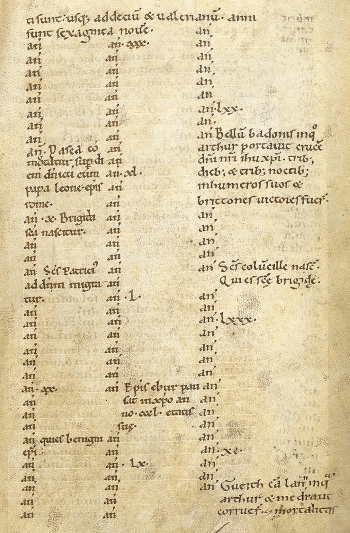
The Annales Cambriae, otherwise known as The Annals of Wales, is a Latin chronicle that was compiled sometime during the 10th-century and recorded brief entries for significant events that happened across centuries of Welsh history. Like the Historia Brittonum, it sits at the center of debates about whether King Arthur was a historical figure. The Annales Cambriae’s two entries that mention him are among the earliest datable written references to Arthur, yet neither entry was recorded at the time of the events it describes. In fact, they were recorded around 300 years after the events had supposedly taken place, (Mees, 150). This makes the entries impossible to use as proof of historicity. The second entry, for what scholars date to approximately 537 CE, records the “Battle of Camlann.” Mees makes a crucial linguistic observation about this entry, as the spellings Gueith, Arthur, and Medraut in the surviving manuscript are linguistically later than a sixth-century original would produce, as “the expected sixth-century forms would be *Vecht, *Artur and *Medrot,” (90). The spellings we read today were updated by later copyists. This was a common practice in medieval manuscript transmission. Spelling, in this period, is a datable artifact.
“Gueith cam lann inqua arthur et medraut corruerunt. et mortalitas inbrittannia et in hibernia fuit”
Translation: “Strife of Camlann in which Arthur and Medraut fell. And a mortality occurred in Britain and Ireland.”
-Annales Cambriae, approximately 537 CE
WHAT DOES ORAL TRADITION MEAN FOR THE LEGEND?
One of the most significant consequences of oral storytelling is that variant versions of a story can coexist without contradiction. As Snyder notes, Welsh tradition records Arthur as having been married to three different women named Gwenhwyfar without treating any one version as the incorrect one, (84). Oral tradition doesn’t require a single authoritative text, as stories are expected to vary between performers and occasions. When monks and scribes began committing these stories to writing, they had to make choices: which version, whose Arthur, and what ending. This made every act of writing into an act of selection that was shaped by the political, religious, and linguistic context of the scribe writing it. Nennius’ Latin and the Welsh of The Annales Cambriae preserve different versions of King Arthur and Arthurian legend as a whole. This isn’t because one is more accurate, it’s because each version of Arthur served different communities, cultures, languages, and purposes. The legend of King Arthur is inseparable from the history of the languages that carried it.
 The Word In The Stone