1800’S–PresenT DAY
From the Victorian era to the present day, each retelling of the Arthurian legend is shaped by the linguistic tools that were available to its author, and by what those tools can and cannot convey.
Linguistic Question:
As English becomes a fully analytic language, how do writers from different eras each use style and vocabulary to recreate the moral weight that grammar could once provide on its own?
THE LANGUAGE HAS CHANGED AND SO HAS ARTHUR
By the 19th century, English had completed its transformation into a fully analytic language. This transformation had been centuries in the making. The Norman Conquest had taken away much of the Old English inflectional system by placing French at the top of the social hierarchy. Contact with French, which was a less inflectional/synthetic language than the Latin that English had been strongly influenced by, accelerated the loss of case endings and grammatical gender that Old English had once relied on using. Then, the Great Vowel Shift restructured the entire sound system of the English language between roughly 1400 and 1700, (Gramley, 74-75). By the time the Victorian era arrives, the result of all of this is a language that has lost almost all of its grammatical endings and instead relies on word order, prepositions, and context to signal meaning.
This matters for the Arthurian legend because the grammar that had once encoded moral and social relationships directly is gone. Old English and Latin could signify hierarchy, obligation, and loyalty through the endings of words themselves. Modern English cannot. Snyder observes, “Arthur has arisen to speak to a new generation, and again he speaks in their own language,” (165). The question each era answers differently is: what does their language allow Arthur to say?
TENNYSON: ARCHAISM AND VICTORIAN VALUES
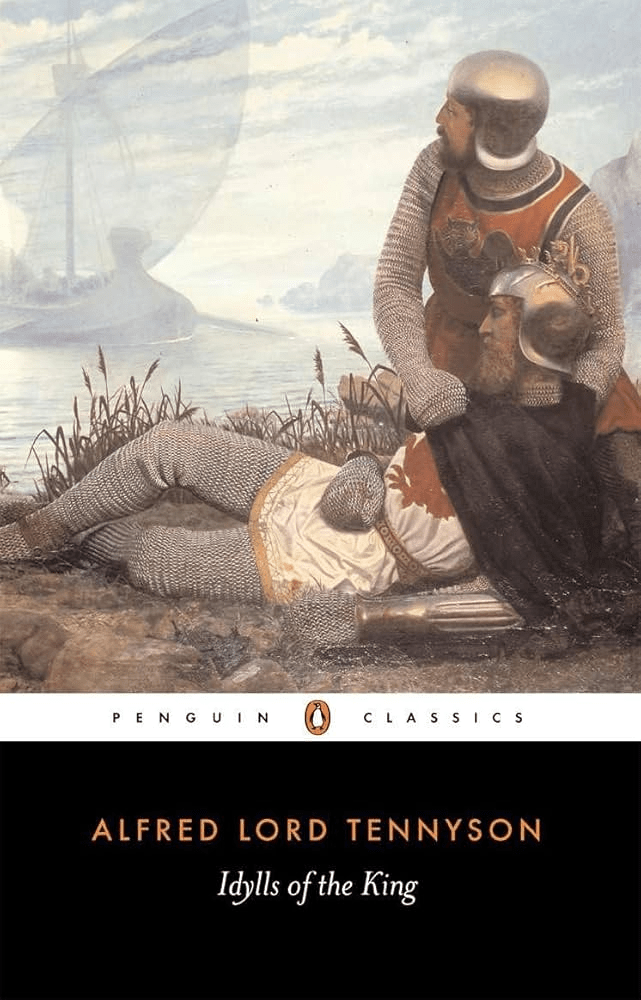
Idylls of the King is a series of twelve narrative poems by Alfred Lord Tennyson that were published between 1859 and 1885. Idylls of The King draws inspiration directly from Malory’s Le Morte d’Arthur to retell the rise and fall of King Arthur’s court. It’s considered the most influential Arthurian retelling of the Victorian era. This is because it shaped how people understood the legend for generations. Idylls of the King makes its most deliberate linguistic choice on every page: archaism, which is when words and phrases from an earlier time period are used to add different connotations like humor, formality, or antiquity into writing. Tennyson writes in blank verse with elevated diction and vocabulary drawn from an even older English than the Victorian English/Late Modern English of his time, (Snyder, 144). The intentional elevation of Tennyson’s language encrypts Victorian ideology within the story. Tennyson’s version of Arthur embodies the Victorian values of gentlemanly chivalry and moral purity. The archaic register Tennyson writes Idylls of The King in makes these Victorian values feel ancient and inevitable. An example of Tennyson’s archaic writing style can be seen in:
“The old order changeth, yielding place to new, / And God fulfils himself in many ways, / Lest one good custom should corrupt the world.”
Alfred Lord Tennyson, “The Passing of Arthur,” Idylls of the King, 1885
Neither the verb “changeth” or the formal biblical register are natural Victorian English. They are examples of Tennyson’s carefully constructed archaism that signals moral and historical weight within Idylls of The King.
TWAIN: AN AMERICAN VOICE
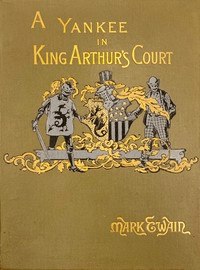
Writing from outside the British tradition entirely, Mark Twain brought a new transatlantic American perspective to the legend. As Snyder notes, “whereas Tennyson saw Arthur as part of his own tradition and relevant to a progressive society, Twain saw Arthur merely as a symbol of the decadent ancient régime of a Europe pulling itself too slowly out of feudalism and serfdom,” (143). In Twain’s 1889 novel, A Connecticut Yankee in King Arthur’s Court, the narrator is a 19th century American engineer who is transported to Camelot and applies modern industrial logic to a society built on chivalric hierarchy and medieval superstition. The comedy of the novel depends entirely on the collision of two registers here, as the elevated archaic language of the Arthurian court is set against the flat and practical American English of the narrator. Twain simply let the two languages sit next to each other and allowed the contrast to do the comedic work for him. Tennyson’s Idylls of the King and Twain’s A Connecticut Yankee In King Arthur’s Court are evidence that, despite being written at virtually the same historical moment, the same legend can serve opposite purposes depending on the language chosen to tell it.
T.H. WHITE: REGISTER SHIFT AS EMOTIONAL ARCS
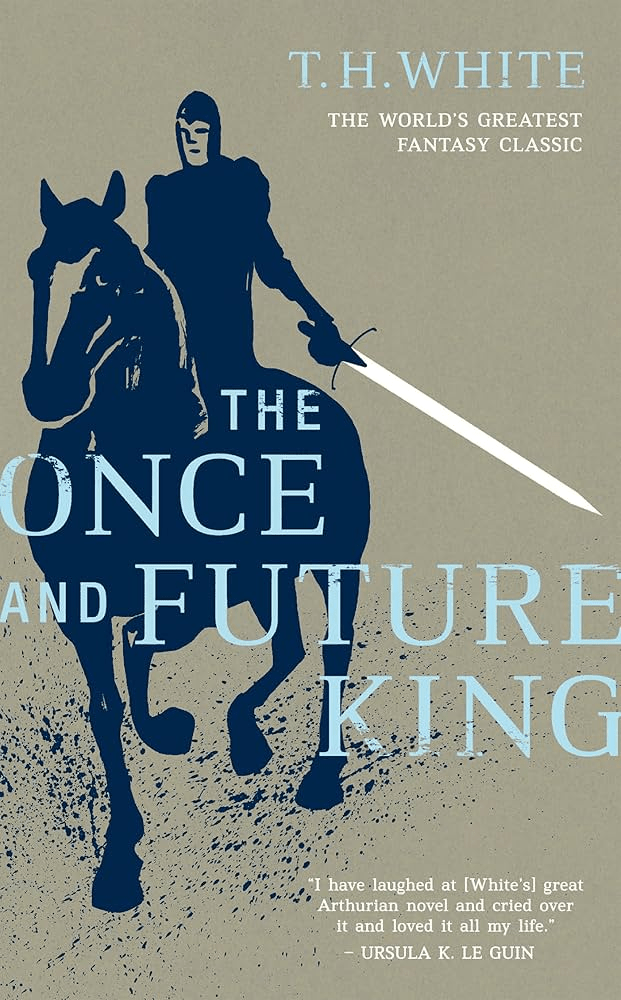
T.H. White’s 1958 book, The Once and Future King, makes perhaps the most creative structural use of register in any modern retelling. White opens the story with cheerful and conversational 20th-century English. Merlin uses modern slang, the young Arthur stumbles through his education with warmth and humor, and the whole first section refuses to utilize the moral gravity that Tennyson’s archaism provided. The lightness of the story is deliberate. This is because White was, “writing at the outbreak of World War II, placing Arthur’s chivalric worldview against Nazism and Communism,” (Snyder, 167) and the contrast between the novel’s playful opening and its eventual darkening end is the point.
As the plot of The Once and Future King turns towards betrayal and the final battle, the prose shifts with it. It becomes more formal, more elegiac, and closer in feeling to Malory’s prose. The jokes stop. The sentences lengthen. The lightness drains out of the story gradually rather than all at once, so that by the time the end arrives the reader has already felt the language change and shift. White doesn’t just describe the tragedy of King Arthur. He enacts it through the transformation of his prose style, and the reader experiences the loss of the earlier register as its own kind of grief.
BRADLEY: NEW VOCABULARY AS RECLAMATION
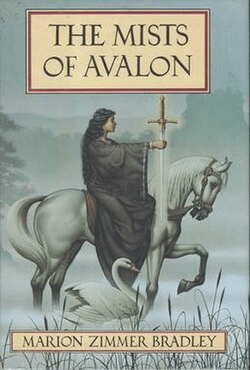
Marion Zimmer Bradley’s The Mists of Avalon, published in 1982, makes an ideological argument through vocabulary. Snyder describes the novel as featuring, “an unlikely heroine Morgan, a proto-feminist priestess of Avalon battling the evil forces of Christianity,” (167). Bradley uses the modern vocabulary of psychology and spiritual autonomy to tell a story from perspectives that the earlier tradition had marginalized. The plot events are nearly identical to Malory’s, but the moral grammar, especially surrounding the female characters, is opposite. This transformation is enacted entirely through the vocabulary of mysticism and resistance that modern English makes available.
 The Word In The Stone