A Character Study
Linguistic Question:
If a character like Morgan Le Fay can be a healer in one language and a villain in another, or a character like Merlin can be a wild prophet in Welsh verse and a wise advisor in Latin prose, what does that tell us about what language and culture do to the stories they tell?
ARTHUR: A KING SHAPED BY LANGUAGE
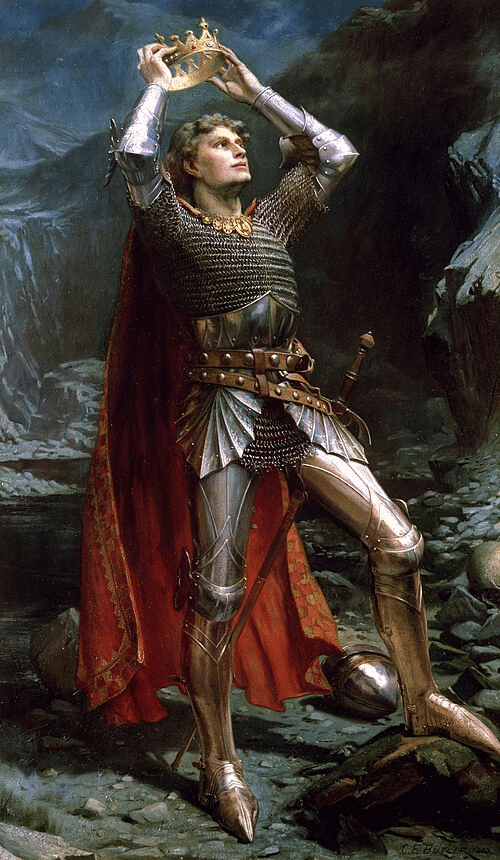
King Arthur’s story begins in the Welsh oral tradition with Arthur being a character that is already so well known that the bard/poet Aneirin could reference him in passing without any prior introduction. Here, Arthur is not yet a king. He is a standard to meet, to compare to, and a name that carries weight without needing any explanation. That is in itself evidence of how deep the Arthurian legend ran before anyone had ever wrote it down.
As the legend begins in Welsh and moves into Latin, then goes from Latin into French, and then English, the character of King Arthur transforms in step with the language carrying him. Geoffrey of Monmouth gives Arthur that Roman imperial ambition and frames his conquests as history. Through his Latin writing, Geoffrey makes Arthur a king. Wace then translates that king into French and gives him the Round Table. This reframes his authority as a courtly fellowship, instead of military command. By the time that Malory writes in Middle English, Arthur presides over a court whose entire moral vocabulary, honor, worship, and nobility has become French in origin, despite the writing carrying it being in English. The French layer is so thoroughly absorbed into Arthurian legend that it no longer feels like borrowing. It feels like what chivalry simply is.
What changes most across retellings is not Arthur’s actions or characterization, but what his death/tragedy represents. In Malory’s Le Morte D’Arthur, it’s a moral tragedy. It’s the collapse of a chivalrous code that demanded too much from flawed people. In Tennyson’s Idylls of The King, Arthur’s tragedy is ideological. Tennyson creates this through gradual archaism in his writing that makes Victorian values feel ancient and inescapable. In White’s Once and Future King, the tragedy is political. It displays the failure of a man who tried to replace power with justice, but couldn’t.
MERLIN: WILD BARD TO WISE ORACLE
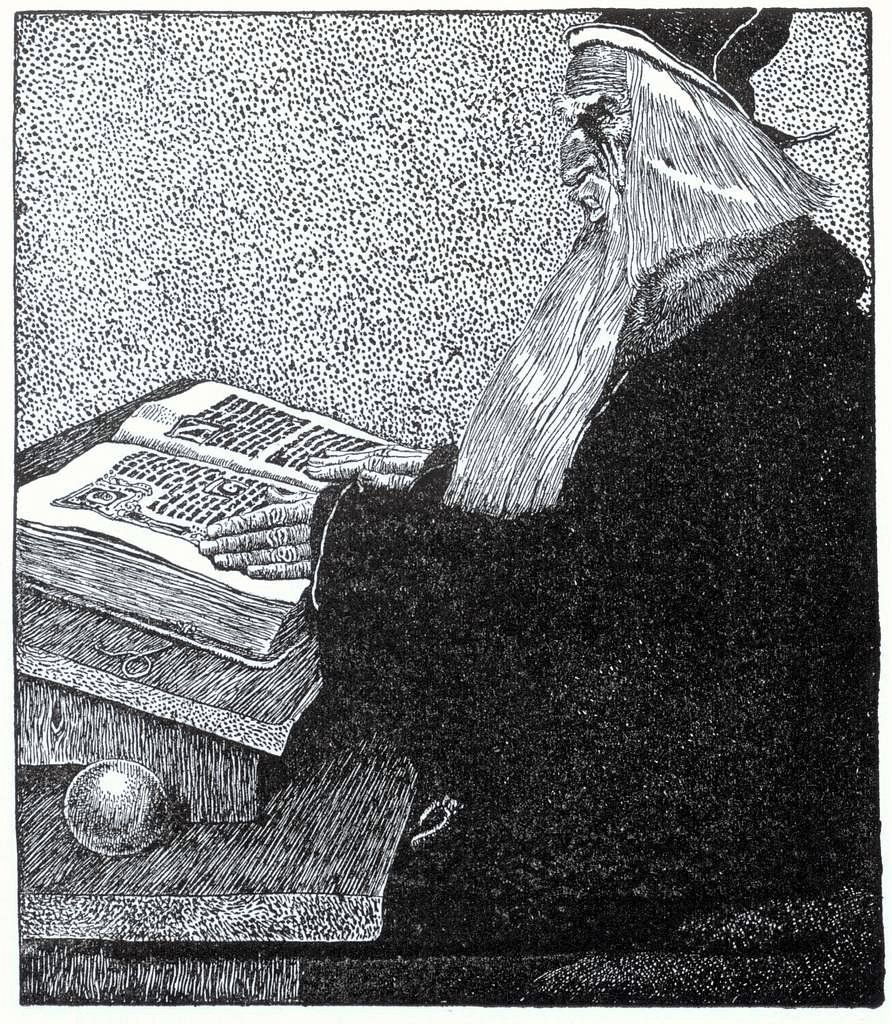
The earliest version of Merlin in Arthurian Literature is “Myrddin.” Though Myrddin is attributed as the narrator/writer of several ancient Welsh poems, such as in several poems from The Black Book of Carmarthen (one of the earliest surviving Welsh manuscripts,) it’s unclear whether he was ever a real person, or simply a fictional narrator a poet chose to use. Either way, Myrddin appears to have been a Welsh bard who fell into madness after a great battle and, as Snyder describes, ran “wild into the forest uttering prophecies and keeping fellowship with animals,” (95). His knowledge is shown through fragmented alliterative verse from entirely outside civilized society. The earliest version of Merlin, or Myrddin, is irregular, and belongs to no one’s politics.
Geoffrey of Monmouth, in an explicitly linguistic act, first transforms Myrddin into Merlin in the Historia Regum Brittaniae. As Snyder notes, “It has been assumed that Geoffrey created the name Merlinus, choosing this Latin form for Myrddin over Merdinus (in French, merde) because of the scatological connotations of the latter,” (157) as merde is a French exclamation meaning “shit” or “crap.” He then translated Myrddin’s fragmented Welsh verse into polished Latin prose, shifting wild knowledge into the register of legitimate political discourse and wisdom. The wild Welsh voice of Myrddin became the authorized Norman oracle that is Merlin/Merlinus. As Snyder observes, Geoffrey was also “the first to link the figures of Arthur and Merlin,” (95). Because this happened in Latin, at the time Merlin’s “knowledge” could be cited and regarded as actual wisdom.
By the time of Malory, Merlin speaks in the plain prose of practical counsel. His prophecies are still around, but now they’re integral to the plot, instead of cryptic nonsense. The Merlin in White’s Once and Future King even reclaims some of that original cryptic nonsense and strangeness by making Merlin’s anachronistic speech comedic. His speech stands out among the modern English register within the novel. He becomes a figure whose wisdom and foresight is at first viewed as funny, because he is one of the only people speaking that way, but it ultimately becomes tragic. In each case of Merlin, what he sounds like seems to tell us what kind of knowledge his era considered trustworthy, or not.
LANCELOT: THE FRENCH LAYER
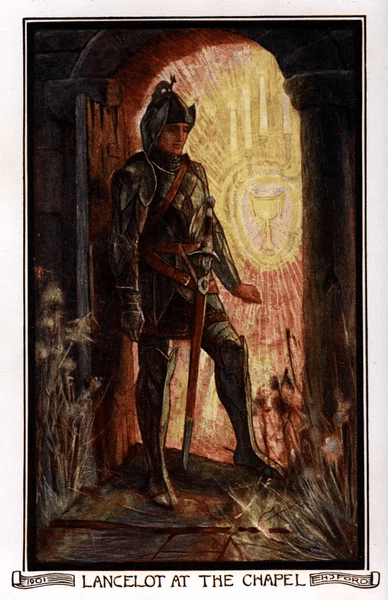
There is no character in Arthurian legend that more visibly marks the Norman transformation of the legend than Lancelot, as without it he wouldn’t exist. As Snyder states, he “is, like Camelot, almost entirely a creation of the French poets” with “no clear counterpart in the Welsh tradition,” (105). He first appears in Chrétien de Troyes’ works of Arthurian literature around 1170. He is built entirely from the vocabulary of Old French courtly love. The over 10,000 French loanwords that entered English in the Middle English period, as documented by Gramley, include the entire chivalric vocabulary through which Lancelot is defined: “honour,” “courtesy,” “noble,” “worship,” and “adventure,” (84). Every author who includes Lancelot is working within the conceptual framework that Old French constructed and planted in Arthurian legend.
MORGAN LE FAY: MADE A VILLAIN BY TRANSLATION
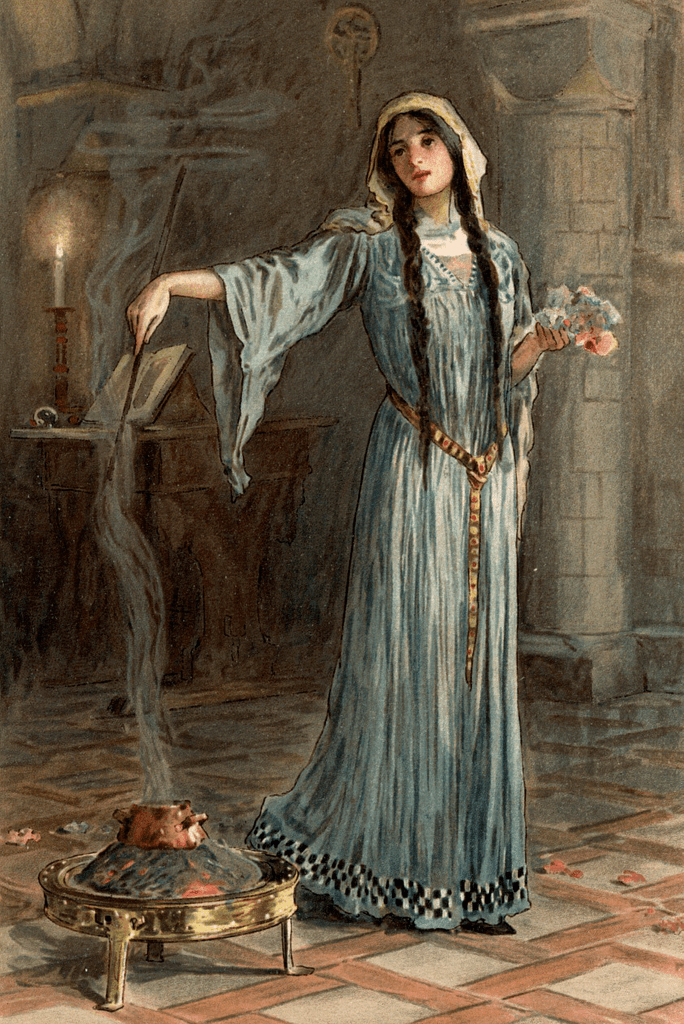
Morgan le Fay is often regarded as an evil enchantress/sorceress in most modern Arthurian literature and media, but she was once known only as a great healer. Morgan le Fay’s transformation from healer to villain is one of the most traceable character arcs in Arthurian legend, and it follows the same linguistic path.
Morgan first appears in Geoffrey of Monmouth’s “Vita Merlini” or “The Life of Merlin” as “Morgen.” She is described as “the eldest and most beautiful of nine sisters, skilled in the arts of healing,” (Snyder, 85) and the ruler of the Isle of Avalon. Her origins are believed to trace to pre-Christian Celtic goddess figures whose authority was bound up in land, battle, and healing simultaneously, (85). In Geoffrey’s Latin, she is not threatening. She is necessary. Without her, King Arthur would have died, as she heals him and brings him back from the brink of death in Vita Merlini.
The French romances perform her transformation from healer to villain through a vocabulary shift. As the legend moved into Old French and the chivalric tradition that Chrétien established, “Morgan la Fee” acquired a new register. The words surrounding her shifted from healing and beauty into supernatural threat, sexual transgression, and scheming against Arthur and the Round Table. The same character became the opposite of who she was first portrayed as, as she was carried into a different language and cultural moment. This is not through any change in her actions, but through a change in the vocabulary used to describe her actions. The feminine power that had been coded as sovereignty in Celtic tradition gets recoded as evil witchcraft in the French chivalric register.
Malory’s Le Morte d’Arthur takes on both versions of Morgan and keeps them unreconciled. In Le Morte d’Arthur, Morgan is both a healer and a villain. This contradiction is no mistake. It’s an intentional record of two linguistic moments remaining unresolved in Middle English prose. Modern retellings, particularly Marion Zimmer Bradley’s Mists of Avalon, resolve this contradiction in characterization in the healer’s favor by using the modern vocabulary of psychology and spiritual autonomy that simply did not exist as a literary register in 1485 to describe her, (Snyder, 166). This portrays her in a better light, as a powerful and spiritual healer.
 The Word In The Stone
