1200’s–1485
English was reclaiming Arthurian mythology, but in a language that had been fundamentally transformed by the French it was now absorbing after The Norman Conquest.
Linguistic Question:
What does it look like when a language is changing in real time, and how can we read those changes in the literary texts that are written during them?
ENGLISH RECLAIMS THE LEGEND
By the 13th century, something significant was shifting. French had dominated English literary culture for over a hundred years, but as Gramley notes, “from 1250 there was a growing body of literature in English, which was concomitant with the spread of English among the upper classes,” (106). The types of literature that had previously appeared only in French, including romance, “now appeared in English,” and as Snyder confirms, Arthur appears in “no fewer than twenty Middle English romances written between the latter half of the thirteenth century and the beginning of the sixteenth,” (121). English was reclaiming the legend, but in a language mid-transformation.
A LANGUAGE IN TRANSLATION
Middle English was not a stable language. It was a language mid-transformation. Gramley describes the period as witnessing “the decay and widescale loss of inflectional endings,” (74.) Nouns lost their case and gender distinctions. The result was a shift from a synthetic language which relies on word endings to signal grammatical relationships, to an analytic language that relies instead on word order and prepositions.
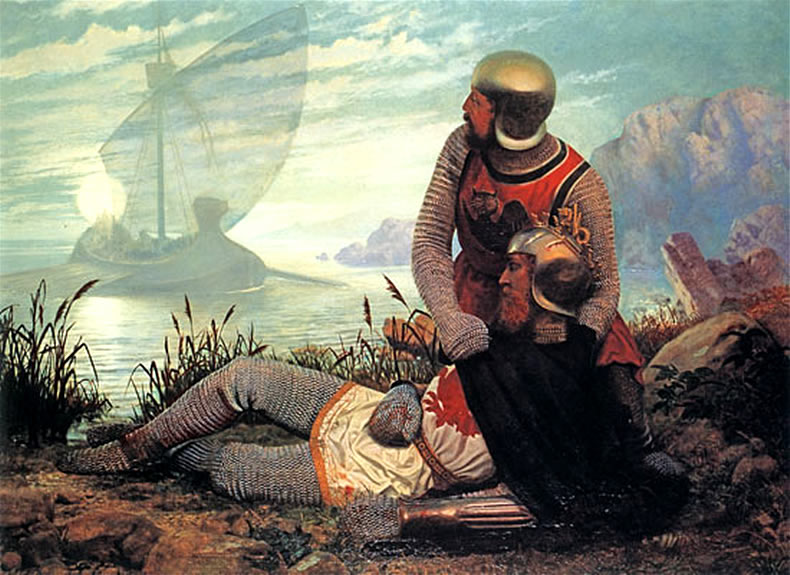
This linguistic transformation can be seen in the Arthurian literature that was produced during the Middle English period. One major example of this, is the poem, “Alliterative Morte Arthure” by Anonymous (~1400). This poem draws from Geoffrey of Monmouth, Wace, and Layamon, by reaching back to the chronicle tradition in its sources and verse form, (Snyder, 124). The story of “Alliterative Morte Arthur” follows King Arthur’s military campaigns and his final battle which ultimately leads to his tragic death. It’s written in the Old English alliterative style, which centers around repeated stressed syllables instead of rhyme. This gives the poem an archaic quality that sets it apart from the French-influenced romances of the same era.
In contrast, the “Stanzaic Morte Arthur” by another anonymous poet (~1400) draws from the French prose, “Mort Artu.” This is the same French source that would later feed the work of Sir Thomas Malory, (Snyder, 123). The “Stanzaic Morte Arthur” centers on the fall of Camelot through the love affair between Lancelot and Queen Guinevere, and, of course, King Arthur’s final battle and death. Unlike the “Alliterative Morte Arthure,” the “Stanzaic Morte Arthur” is written in end rhyming stanzas that reflect the French literary conventions it assumed. Despite these poems being written at roughly the same time, in the same language, about the same story, the “Stanzaic Morte Arthur” and “Alliterative Morte Arthure” represent entirely different linguistic and cultural inheritances.
SIDE-BY-SIDE: Two Middle English Arthurs
Alliterative Morte Arthur (~1400)
“Now grete glorious God through grace of Himselven / And the precious prayer of his pris Moder / Sheld us fro shamesdeede and sinful workes,” (lines 2-4).
Organized around repeated stressed syllables, including both consonant and vowel sounds- Old English alliterative structure
Stanzaic Morte Arthur (14th century)
“Lordinges that are lef and dere / Listeneth, and I shall you tell, / By olde dayes what aunters were / Among our eldres that befell,” (lines 1-4).
End rhyme in an abab pattern: “dere”/”were,” “tell”/”befell” – French courtly performance and literary convention, addressed to a noble audience
SIR GAWAIN AND THE GREEN KNIGHT: DIALECT AND IDENTITY
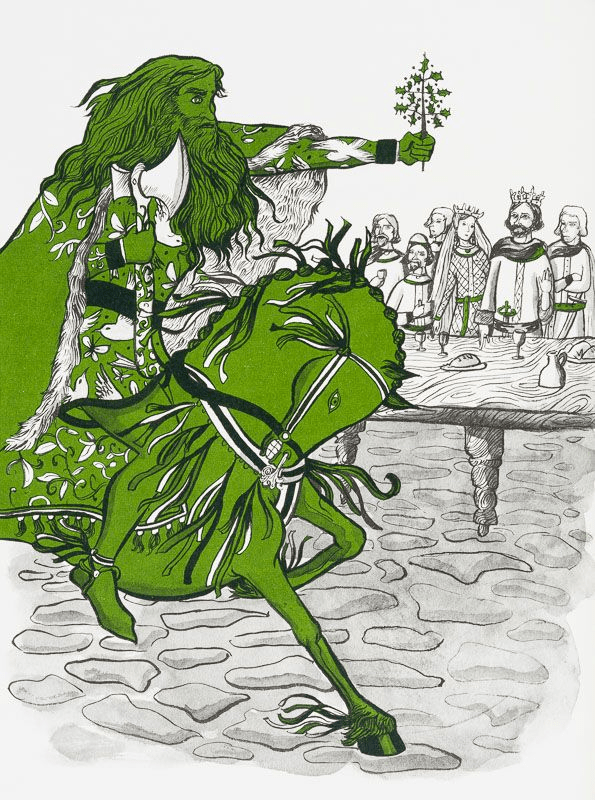
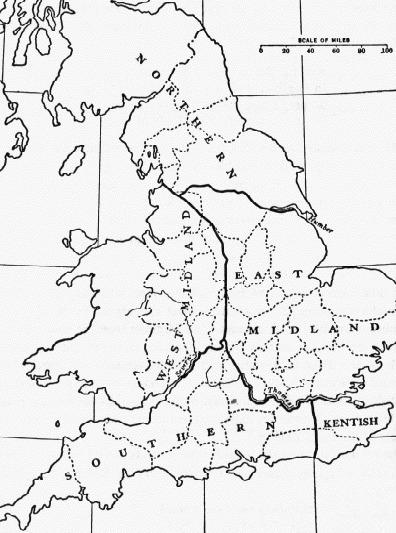
Written anywhere between 1375 and 1400, “Sir Gawain and the Green Knight” demonstrates another important feature of Middle English: it was not one dialect being used, but many. “Sir Gawain and the Green Knight” is a late 14th-century poem written by an anonymous author, often known only as the “Gawain Poet.” The poem tells the story of Sir Gawain’s acceptance of a beheading challenge from a mysterious green knight and the test of courage that follows. The poem is especially notable for the dialect it was written in. The Norton Anthology identifies the poem’s dialect as belonging to “the northwest midlands between Cheshire and Staffordshire,” (412). This is a regional dialect with heavier Norse influence and more conservative spelling than the dialect of east-midlands English (the basis of Modern Standard English). The poem’s audience, the Norton Anthology notes, “would also have understood archaic poetic diction surviving from Old English poetry such as athel meaning noble, and words of Scandinavian origin such as skete meaning quickly,” (412). This was an audience straddling multiple linguistic traditions simultaneously, and producing a version of the Arthurian legend that had not fully absorbed the French hierarchy of characters that Malory would later cement.
MALORY: FRENCH STRUCTURE IN ENGLISH
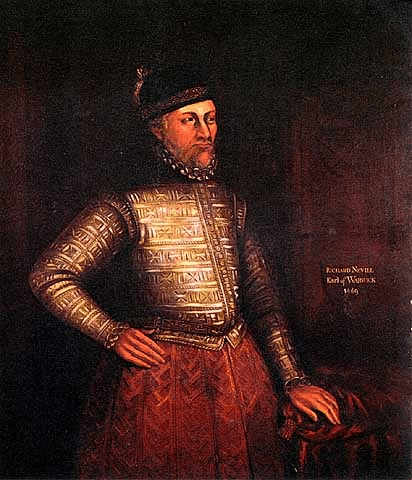
https://www.worldhistory.org/Thomas_Malory/
Sir Thomas Malory’s Le Morte d’Arthur was written between 1469 and 1470 and printed by William Caxton in 1485, and it is the text that consolidated the Arthurian legend into the version that most English readers recognize today. Drawing from French Arthurian literature, like the French poem “Mort Artu,” Malory compiled the sprawling tales of Arthurian romance into one continuous English narrative. Le Morte d’Arthur’s story covers every major event in Arthurian literature from the fall of Camelot to both the birth and death of King Arthur. It remains the foundational text of English Arthurian literature, and every major retelling since it has either built on it or argued against it. Malory’s primary French sources left marks on his prose that are still clear today. For example, this can be seen in the opening of Book I, Chapter I:
“It befell in the days of Uther Pendragon, when he was king of all England, and so reigned, that there was a mighty duke in Cornwall that held war against him long time. And the duke was called the Duke of Tintagil. And so by means King Uther sent for this duke, charging him to bring his wife with him, for she was called a fair lady, and a passing wise, and her name was called Igraine.”
Thomas Malory, Le Morte d’Arthur, Book I, Chapter I, c. 1469–70
If you look at this passage closely, do you notice anything about the way it’s written? “And so reigned,” “And the duke was called,” “And so by means,” “and a passing wise,” “and her name was called,” that is five “and” conjunctions in three sentences, with almost no subordination. Malory chains everything with “and” and “and so,” which is directly inherited from the French prose romance convention of using multiple conjunctions consecutively, like “et… et… et.” The English legend is being told in English words, but the sentence structure is still French in Malory’s Le Morte d’Arthur.
THE GREAT VOWEL SHIFT BEGINS
Malory writes at the beginning of one of the most significant events in the history of the English language: the Great Vowel Shift. Gramley describes the Great Vowel Shift as, “a chain shift involving the long vowels of Middle English,” (122) that began in the Middle English period and continued through the Early Modern period. Long stressed vowels shifted upward in the mouth in a chain reaction. How long you “hold” a vowel for was no longer important. This meant that:
- Middle English (ME) words that used the [i:] sound shifted to using the diphthong [ai] sound in Present Day English (PDE)
- ME: [u:] -> PDE: [au]
- ME: [e:] -> PDE: [i]
- ME: [o:] -> PDE: [u]
- ME: [ɔː] -> PDE: [o]
- ME: [ɛː] -> PDE: [i], though there are exceptions in which it became [e]
- ME: [a:] -> PDE: [e]
The shift is why Malory’s original spellings look strange to modern eyes, as words like “kynge,” “whyte,” and “lyfe” all represent long vowels in the process of shifting. As Gramley notes, “English spelling was largely fixed by the early sixteenth century,” (122) meaning spelling was frozen before the Great Vowel Shift completed, which is why English spelling and pronunciation diverge so dramatically to this day.
 The Word In The Stone
