1066–1200‘s
The Arthur who emerges from this period is almost unrecognizable from the Welsh war-leader he began as and the language that builds him here is almost entirely French.
Linguistic Question
When one language dominates another: which words survive and who gets to decide? What does the Arthurian legend reveal about that process?
A CONQUEST IN TWO LANGUAGES
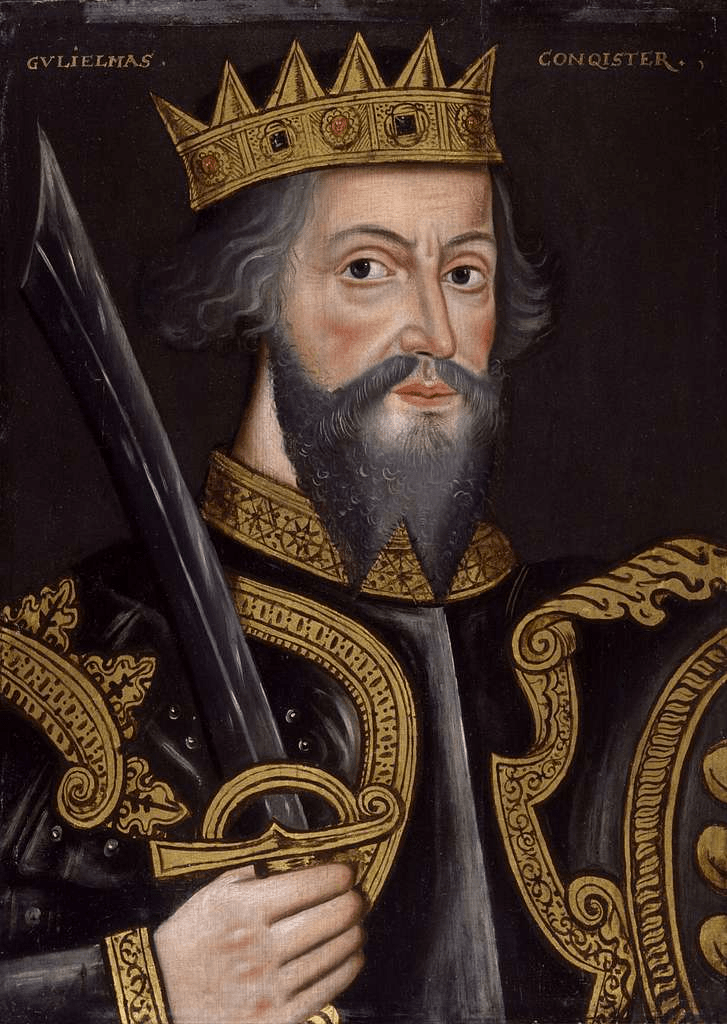
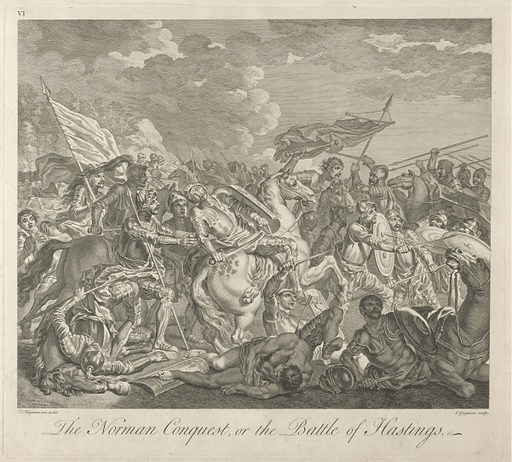
In 1066, William the Conqueror, the Duke of Normandy invaded England and claimed the throne in what is known as, “The Norman Conquest.” The Norman Conquest placed a French-speaking ruling class at the top of the English social hierarchy. This set one of the most significant transformations in the history of the English language in motion. As Gramley, author of The History of English: An Introduction, explains, the Norman Conquest had “a massive long-term effect on vocabulary, changed patterns of word formation, and altered the phonological structure of the language,” (64). However, unlike the Viking settlements that had influenced English from the north, Gramley notes that “there was no large-scale immigration” of Normans, (64). This linguistic change was driven by a small, yet powerful elite class who placed French at the top of the social hierarchy and pushed English to the bottom. This matters for the Arthurian legend because it determined which language the legend would be told in at the time and what values it would carry.
THREE AUTHORS, THREE LANGUAGES, ONE LEGEND
The Norton Anthology of English Literature identifies a defining pattern in how Arthurian mythology primarily traveled during the 12th-century: “three authors, writing in Latin, Anglo-Norman French, and Middle English respectively, created a mostly legendary history of Britain for their Norman overlords,” (139). One of these three authors, and one of the most important authors in the history of Arthurian literature, Geoffrey of Monmouth, wrote his Historia Regum Britanniae (The History of the Kings of Britain) in Latin around 1136 to 1138. He wrote this primarily for, “an audience of noblemen and prelates who were descendants of the Norman conquerors of England,” (Snyder, 139). Wace, a medieval Norman poet, then loosely translated Geoffrey’s work into Norman French in his “Roman de Brut” in 1155. He dedicated “Roman de Brut” to Eleanor of Aquitaine, who was the queen of France from 1137-1152 and queen of England from 1154-1189 and a powerful patron of courtly literature, (Snyder, 140). The English poet Layamon then translated Wace into English alliterative verse in his “Brut” sometime between 1199 and 1225. Layamon produced a text almost twice as long as its French model, and substituted, as Snyder writes, “descriptions of Dark Age brutality for the latter’s talk of love and chivalry,” (89).
WACE AND THE ROUND TABLE
Wace’s most influential addition to Arthurian mythology was an object that neither Geoffrey or anyone before him had never mentioned: the Round Table. As Snyder notes, this was introduced as “round to denote the equality of its members,” (78). The Round Table was a specifically French courtly concept of noble fellowship encoded in a piece of furniture.
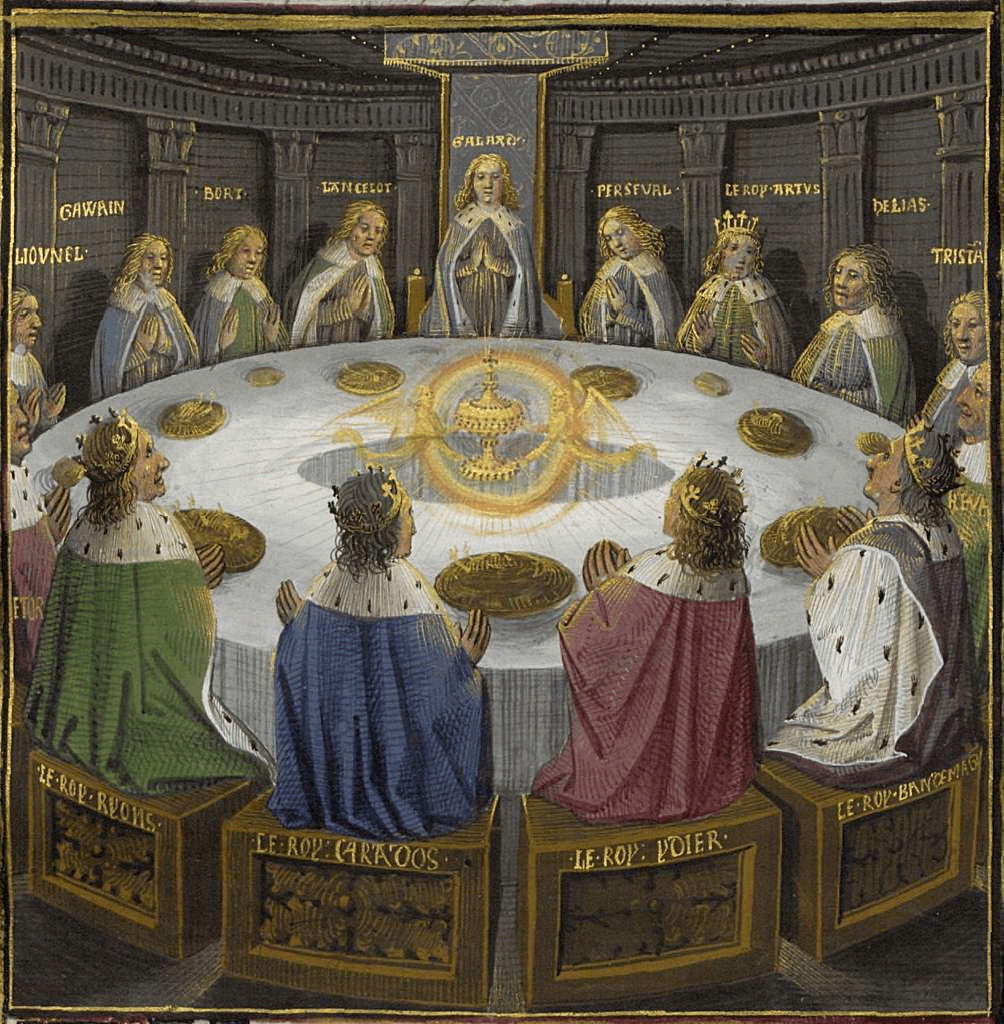
https://picryl.com/media/knights-of-the-round-table-graal-15th-century-12a66b
“Arthur made the Round Table, of which the British make much boast. There sat the vassals, all of them at the table-head, and all alike. The high were equal with the low; none could boast that he sat higher than his peer. None was foreign and none was familiar, for all were of one fellowship at that Table Round.”
Wace, Roman de Brut, c. 1155, trans. Eugene Mason, 1912
The vocabulary here uses words like: vassals, fellowship, and peer. This is the vocabulary of French feudal culture. These words didn’t exist in the Welsh tradition’s description of Arthur’s companions. They arrived with Wace in his poem “Roman De Brut,” and they stayed.
WHAT FRENCH ADDED AND REPLACED
The French layer didn’t just add new vocabulary to the legend. It restructured the entire cultural vocabulary through which the legend was understood. Gramley documents that over 10,000 words were borrowed from French in the Middle English period alone, (84). The categories of French loanwords map almost perfectly onto the legend’s new concerns:
- law and administration: court, council, crown, state, realm, and royal
- military: army, battle, combat, and siege
- art and literature: romance, story, beauty, and poet
- -(Gramley, 85)
Gramley’s evidence is drawn directly from a manuscript of “Brut” by Layamon and shows that Old English words such as, “hlaford” (literally “bread warden”) and the origin of modern lord, were replaced by French with words like, “sire,” in this case. The word meaning “lady” was “hlaefdige,” which literally meant “bread kneader,” and was then replaced by the French word “dame,” (84). The social vocabulary of Arthur’s court was being rewritten word by word into French. The word “romance” itself, originally “romans,” as The Norton Anthology of English Literature explains, originally meant simply “French,” (141). The genre and the word that names it are both French creations, and both entered English together.
CHRETIEN DE TROYES AND THE CREATION OF LANCELOT
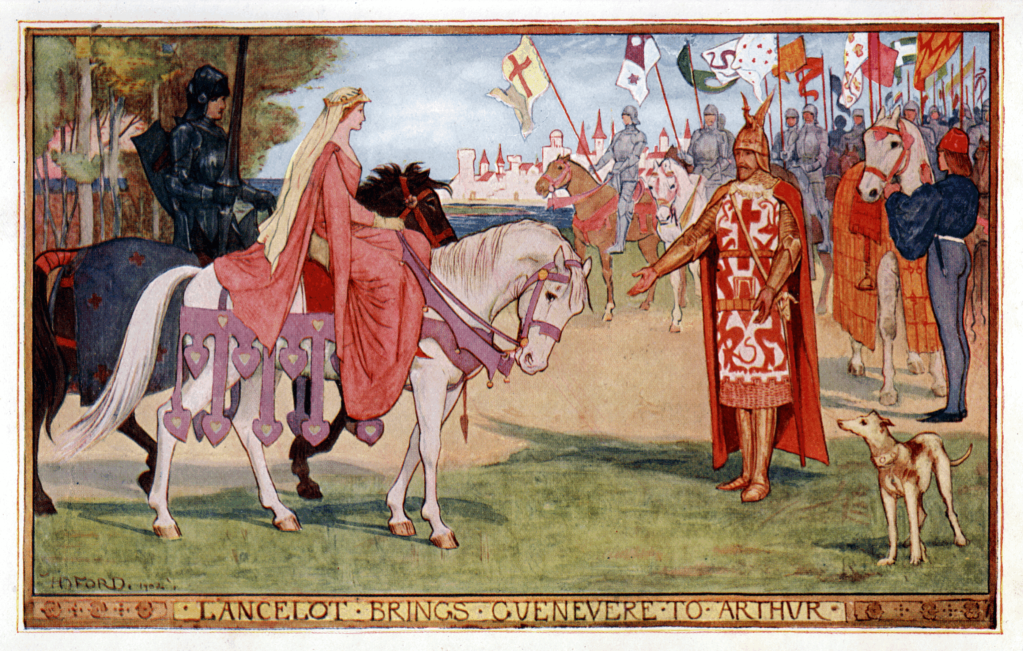
The most consequential transformation of the legend in this period was the work of Chrétien de Troyes, who wrote five Arthurian romances in Old French between approximately 1170 and 1191. Chrétien introduced the fully developed courtly love tradition and, most significantly, invented Lancelot in his poem, “Lancelot, The Knight of the Cart.” As Snyder states plainly, Lancelot “is, like Camelot, almost entirely a creation of the French poets. He has no clear counterpart in the Welsh tradition,” (105). One of the most famous knights in Arthurian legend doesn’t even exist before the French layer arrives, and his presence in every subsequent retelling is a permanent marker of the Norman linguistic transformation of the story.
A LEGEND STRATIFIED BY LANGUAGE
After the events of the Norman Conquest in 1066, England became effectively diglossic, which refers to a society in which two distinct languages serve different social functions. French was the language of court, literature, and law, while English survived in the everyday speech of commoners. As Gramley notes, “French was used at the top and English at the bottom of the social scale,” (67). The legend’s prestige rose as it moved into French. English and Arthurian mythology were already being permanently reshaped by French.
 The Word In The Stone